

Update
January 2026
Upon returning from Kenya we found that we had received much more than we had given. There were six of us, including Allan McDonald, one of our board members, and four members of the Martinson family, who had supported us in installing a well in Maji Moto, Wilson’s community
We were greeted at the airport by James, a six foot six Maasai warrior in full Maasai attire. Many of the other tourists around us wanted to have their pictures taken with him! They come to see the wildlife, but often do not get time to be with authentic Maasai warriors. When we saw him, James laughed generously, hugged us and guided us for the first few days of our time in magical Kenya.

Jackson, James and Wilson
We stayed in a lovely place in Karen, named after Karen Blixen. We went to feed the giraffes at the giraffe reserve and went to the elephant orphanage where groups of baby elephants frolicked in a mud bath. Most of our group then went to the Nairobi National Park, where they had their first experience discovering the wildlife, including lions, zebra, cheetah and hilarious pumba. I stayed back to meet with an attorney to plan for our Land Committee meeting.
After our time in Nairobi, we set off with Jackson and Wilson, our Maasai project facilitators, to stay in the lodges near the communities where our projects are located. We were greeted in the communities by hundreds of Maasai men and women dancing toward us and singing.
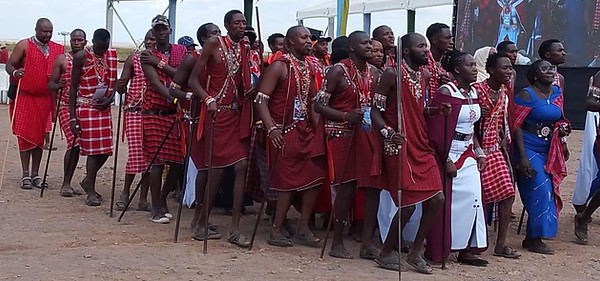
Maasai Dancing as a Greeting
The women were grateful and joyful to have their own micro-businesses. This has turned out to be a great way to empower women and prevent them from feeling the need to sell their land. We have provided over 1,800 women with 50 dollars each and trained them to use the money to take produce to the marketplace to sell and bring the profits home to provide food for their families, pay school fees, share with others in the community, and save a small portion until they each had 50 dollars to pay forward to another woman. Over 1,300 of them had paid the money forward and empowered other women. This process has been powerful and has made an exponential impact. Our group left that experience wanting to find ways to empower more women.

Our Team with Jackson's Wife and Baby
We also visited the wells we installed with your support. Women and children usually are the ones who collect large jugs of water to take home each day. They used to walk long distances with heavy jugs of polluted water, but now they have clean water for the first time. Moreover, the wells are closer to their homes. Since some still have to walk over two hours each way to get water, they asked if they could share the water by piping it to other communities. We decided to have the engineers who installed our wells estimate what that would cost. We promised to ask our friends to help. It will cost $4,680 to pipe the water. That will benefit over 4,000 more people.

We then visited the clinic that we supported the community to build. It is a small but mighty place. The community members greeted us with stories of the impact this has had on the lives of the people. Thousands of people have been treated for illnesses and over 900 healthy babies have been born. The nurse there did, however, point out that they only have one delivery bed, so when there are two women in labor, one has to deliver her baby on the floor. We agreed to find the funds for another delivery bed and other equipment needed in order to provide healthcare in this remote community.
Being Welcomed to the Clinic
The highlight of our trip was that we held a meeting with landowner committee members from all over the county to raise awareness about the implications of selling or leasing their land. The mission of our foundation is to support these people in conserving their culture. Many groups are trying to conserve land and wildlife; however conserving this valuable culture is also critical. We do not want this culture and their land to go the way Native American cultures and land have gone. We brought attorneys and respected leaders such as Jackson and Wilson to present and answer questions. The people who attended were very engaged and motivated to learn how to protect their people and their future. They committed to share their understanding with others so that the Maasai could flourish.
We came home full of gratitude that we had made a difference in the world. We saw that your donations have impacted thousands of lives in meaningful and sustainable ways. We brought home a sense of happiness and connectedness that made our own lives better. We hope that you will continue to support what we are doing. Know that 100% of what you send will go directly to improve lives in powerful, sustainable ways. (Donate here)
With appreciation for all that you have made possible,
Barbara